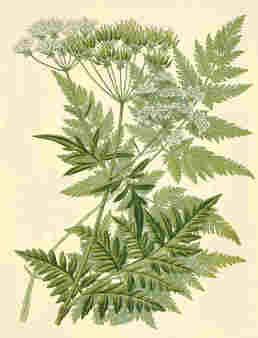
 Anthriscus
cerefolium
Anthriscus
cerefoliumChervil
The fugitive nature of chervil's scent--that it flees from drying and boiling--the finely cut leaves, and the anise fragrance all give evidence of this magic herb's Mercury nature. Some say this native of Eastern Europe and Western Asia was spread through Europe by the Romans, but it is also one of the nine Anglo-Saxon herbs that were considered effective for treating invisible harms, like flying venoms. At one time in Morocco and Algiera, fires were lit on Midsummer and chervil seeds along with asafoetida, thyme, rue, chamomile, geranium, and pennyroyal were added to make an aromatic smoke with which people smudged themselves and their children. They would try to get the smoke to blow over their fields and orchards, and make bundles of burning material to take into their houses to smudge them as well. This herb is clearly helpful for purification and protection, especially at Midsummer. Top
Mundane Uses
Chervil is best when used fresh. Snip new leaves for the strongest flavor. You can preserve chervil in vinegar (try it in champagne vinegar with shallots) or butter, which can be frozen. It's good for flavoring cheese and eggs and can be used with tarragon or as its substitute incooking. In French cuisine, it is one of the fines herbs, which are a group of herbs that must not be cooked too much or they will lose their flavor. These include parsley, chives, tarragon, chervil, and marjorum. Chervil is generally warming and cheering and a good digestive herb; for this reason, some consider it to be ruled by Jupiter. In the 1600s, Gerard said chervil "rejoiceth and comforteth the heart" and recommended it especially to be added to the foods for elders. In 18th-century England, one common way to use chervil was to pound the fresh herb, collect the juice, and add that to a broth when the broth was finished cooking. This gave a green broth which was eaten as a spring tonic. Occasionally one sees references comparing the smell of this herb or its essential oil to myrrh, but that's a different plant entirely, Myrrhis odorata, sometimes known as sweet chervil (more often as sweet myrh or sweet cicely). "Cerefolium," the second half of this herb's Latin name, is actually the name the Romans gave to this plant. There are a few interpretations for this word. One is that it means "leaves of joy," representing this herb's capacity to cheer, and the other is that it means "leaves of Ceres." Another name for chervil is French parsley. Top
How to Grow Chervil
This plant is a biennial, which means that it produces leaves the first year and sets seed the second. The traditional time to sow chervil is under a March New Moon. Soak seeds in tepid water overnight. Choose a bed in a shady area with rich, moist soil. Plant the seeds, barely covering, and moisten the soil. Or you can water first, then sprinkle seeds over a bed, sprinkle compost over that, and lightly firm in with the back of a rake. Thin the plant when they are as tall as your finger to 12"/ Cut off the flowers as they appear, because flowering can cause the flavor to change. Chervil doesn't like too much heat and will bolt (form seeds and no longer be very good tasting) if it is hot. In North America, it is often grown in spring or fall to escape our hot summers. Since fresh is much better than dried, grow some in a pot on a bright windowsill (in the east is good) in winter. This plant comforteth and rejoiceth the hearts also of rabbits, so if you've got them in your garden, you might want to protect your chervil. The mature plants can look like poison hemlock, so don't grow them anywhere near each other. They do smell different. It is always best to keep banefuls in their own separate place so that they cannot ever be confused with food plants. General growing info Top
Anthriscus
cerefolium
Chervil "Vertissimo"
100 seeds $3.75

© 2008-2024 Alchemy Works; No reproduction without permission
Uses in Witchcraft & Magic:
Protection Spells
Smudging
Purification
Mercury Herb