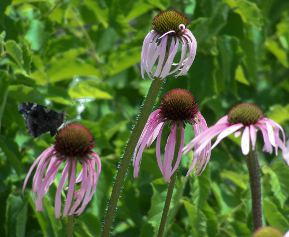
 Echinacea pallida Echinacea pallidaPale Purple Coneflower The Meskwaki folk dub this plant "the hairs on Grandmother Earth's head." Many characteristics of this magic herb indicate its Crone nature. It has an all-over dryish, Crone feel to it and is very wild plant in its form and in its toughness. It forms a tap root, strong and deep-reaching, not only tolerating drier conditions than the more common purple coneflower (E. purpurea), but pulling up nutrients from deep below the level available to more shallow-rooted plants. The tap root also means that it can be difficult to shift, so plant it where you want it to stay. It also blooms before purple coneflower does, flowering in early summer and providing good forage to butterflies when not much else is in bloom. Deer don't like it much on account of its rough stems. Flowers can be pink, magenta, or white but tend to be an Elder's faded rose or lavender color. Petals normally hang down, as in the picture, which to some indicates a Crone nature. This plant is threatened in Tennesee and Wisconsin, so if you live there, growing this plant will help bring it back in its native territory (these seeds are harvested from cultivated plants in Minnesota). The blooms are gently fragrant and make nice cut flowers. The name "echinacea" comes from the Greek word for hedgehog due to the spikey seed head. The Cheyenne used a decoction (mash fresh plant material, boil for 8-10 minutes, and strain) of the roots for various medicinal purposes, including as a drink for arthritis, rheumatism, measles, mumps, even smallpox, and as a wash for burns. They infused the roots and leaves for sore throat, sore mouth and gums, and chewed the roots for toothaches. The Dakota and Sioux both used it as a treatment against snakebites and stinging insect bites. They chewed the root for colds but also as a means of remedying thirst. Despite this being not your typical Venus plant, it does have strong Venus aspects in its use for skin conditions and remedying Mars injuries (stings and bites of venomous critters). This is Venus not as Maiden or Mother but as Crone, who has the wisdom to remove poison, to go deep below, to tough out hard times, that has a somewhat rough and prickly nature but that is generous with healing and food. How to Grow Pale Purple Coneflower: This seed needs cold stratification for 90 days. Transplant to full sun and soil on the dryish side. Plant 1-1.5ft/30-45cm apart. The first year it establishes itself vegetatively and then flowers from the second year on. It is a perennial to zone 3 (down to -40F/-40C). Pale purple coneflower gets 3-4ft/90-120cm tall. Goldfinches love the seeds, so if you want to harvest any, you might want to bag a flower head or two. Then collect the seeds after a heavy rain, when the seed heads become soft and easier to break them apart and pick out the seeds. Harvest roots in fall, after the visible part of the plant is brown and dead-looking, preferably at the New Moon or when Moon is waning. Chop and tincture in high-proof alcohol, like 151 rum, or chop and dry to preserve for later use. Otherwise, the seedheads are very prickly. Divide clumps every 3-4 years to renew flowering. General growing information Top
|
Echinacea pallida
Crone Work © 2011-2024 Alchemy Works; No
reproduction without permission |
Alchemy Works products are offered for use in spiritual, ritual, meditative, and magical practices, not for medicinal or cosmetic purposes. The information on this website is provided for its folkloric, historic, and magical value. It is not intended to be a substitute for professional medical advice, diagnosis, or treatment.