|
This plant represents regeneration because of how quickly it grows from any part that is planted and because Elder is the thirteenth month of the Celtic tree calendar. As the month of death and rebirth, it has three days: past, present, and future. Amongst northern Europeans, who have cultivated it since the Stone Age, cutting a branch from this shrub was thought to offend the elder mother (for the Norse, Freya) who lived inside it. Similarly, in the Middle Ages, people believed that witches lived in these plants and would not sleep beneath them, partly because of the plants's scent, which was considered narcotic, and probably partly because the plant sends chemicals into the soil that keep other plants from growing beneath it, showing it does not like being crowded. In England, people said that burning the wood of this shrub on the hearth would bring the Devil to sit on the chimney, and in many areas, only its flowers, twigs, and berries were used. Later, however, people tied elder leaves in bunches and put them at the windows and doorways of their houses to keep witches out. In Ireland, elder provided wood for wands and for pipes played upon to call spirits. Some people wore elder flowers at Beltane to symbolize their knowledge of the Craft. The edible berries this tree bears make it a Venus plant, but this is Venus as Crone. This tree is also known as Alhuren, Battree, Devil's Eye, Eldrum, Ellhorn, Fau Holle, Hollunder, Hylantree, Hylder, Lady Ellhorn, Old Gal, Old Lady, Pipe Tree, Sweet Elder, and Tree of Doom. How to Grow Elder Elder seeds germinate best when direct sown in the fall in very rich soil with plenty of compost. You can also use flats or gallon pots outdoors. Plant them 1/2" deep in a moist, shady area. These seeds have built in dormancy and require cold stratification. If outdoor treatment is not possible, give 70 days warm, moist conditions (70 degrees F) using a propagation pad, then refrigerate for 90 days, then plant in a greenhouse or outdoor conditions. You can also start with the soaking method (note, unlike many other plants, floating elder seeds are still viable). Once germinated, seedlings grow rapidly. If using containers, choose one that is wide--elder likes to spread its roots. Keep them in a shaded place in their pots for a year before transplanting to final location. Elder loves nitrogen, so use plenty of compost. Hardy from zones 3-11, flowers appear in year 3 in late spring, with ripe berries at the height of summer. European elder is a multi-stemmed shrub (or small tree) that grows from 8-20' (sometimes taller). Top |
Elder
Berries, Organic Elder Flowers Grow an Elder Tree 
Crone Work © 2004-2023 Alchemy Works; No reproduction without permission |
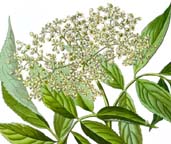 Elder
Elder