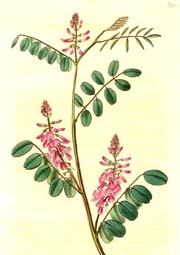
 Indigofera tinctoria
Indigo
The dye made from this Saturn plant is produced by fermentation and has been used in Asia for over 5000 years. At the beginning of the 17th century, it replaced woad in Western Europe as the blue dye of choice because of its greater strength. Despite its rather complicated preparation, indigo is one of the few blue dyes from nature, it does not fade, it dyes in cold water, and it requires no mordant. In early America, some types of indigo were so valued that cubes of it were used as money, and it was a valuable crop on Sea Island plantations, where slaves were made to stand in the vats and oxygenate the dye by paddling it for 2-3 days. In India it is known as black henna and employed in hair dye and hair dressing oils as well as body decoration; there the British Empire forced peasants to grow it for export instead of rice for food because the British so valued the color. It also plays a role in Traditional Chinese Medicine, where the herb's bitterness is applied to stop bleeding and as an antiseptic. Indigo red, a brown aspect of the dye, has been shown to be effective against leukemia. This plant is a legume, which means it fixes nitrogen in the soil. It also kills nematodes. The color indigo represents the Third Eye and is traditionally associated with deep meditation and great stillness. Top
 How to grow
Indigo: This tender
perennial needs hot, humid weather and a mild
climate, but it can be grown in more northern
climes as an annual. Nick with a sharp knife away from
the "eye" of the seeds or rub the seeds gently between
sand paper for 2-5 minutes to wear off part of the coat and then
soak for 24 hours in warm water. Because many people
germinate these seeds using an acid to cut through the hard seed
coat, this is a good seed to try a hydrogen peroxide soak with;
instead of nicking or rubbing with sandpaper, soak in a mixture
of 1 part hydrogen peroxide solution like you get from the store
with 9 parts filtered water (no chlorine) for 24 hours. Drain and
plant in peat pellets soaked in a solution of liquid kelp, which
helps germination. If possible, use fluctuating temperatures between
68F/20C at night and 86F/30C during the day; bottom heat on a timer
or just turn it off at night can speed germination after sowing, but it can still take
over a month to germinate. It likes
full sun and grows 3-6ft/90-180cm tall. Transplant to
full sun 3ft/90cm apart. You can
harvest the leaves up to four times a year.
General
growing info.
Top
How to grow
Indigo: This tender
perennial needs hot, humid weather and a mild
climate, but it can be grown in more northern
climes as an annual. Nick with a sharp knife away from
the "eye" of the seeds or rub the seeds gently between
sand paper for 2-5 minutes to wear off part of the coat and then
soak for 24 hours in warm water. Because many people
germinate these seeds using an acid to cut through the hard seed
coat, this is a good seed to try a hydrogen peroxide soak with;
instead of nicking or rubbing with sandpaper, soak in a mixture
of 1 part hydrogen peroxide solution like you get from the store
with 9 parts filtered water (no chlorine) for 24 hours. Drain and
plant in peat pellets soaked in a solution of liquid kelp, which
helps germination. If possible, use fluctuating temperatures between
68F/20C at night and 86F/30C during the day; bottom heat on a timer
or just turn it off at night can speed germination after sowing, but it can still take
over a month to germinate. It likes
full sun and grows 3-6ft/90-180cm tall. Transplant to
full sun 3ft/90cm apart. You can
harvest the leaves up to four times a year.
General
growing info.
Top
Indigofera tinctoria
Indigo
50 seeds $4.00

Uses in
Witchcraft & Magic:
Saturn Herb
We also have genuine indigo
Other Dye Plants:
Woad
Weld
Dyer's
Chamomile
Dyer's Broom
Dyer's
coreopsis
Safflower
© 2004-2024 Alchemy Works; No reproduction without permission