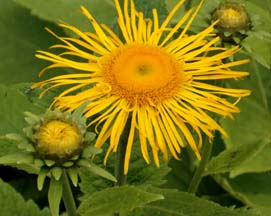
 Inula helenium - Seeds & Dried Root
Elfwort, Elecampane
This magick herb is said to be a favorite plant of the Elves, but it is also used against Elvin magic: stabbing the root renders an Elf spell null and void. It is also used to attract fairies, although it is a big, rough plant and not at all delicate, as one would expect from a fairy plant. In Germany, it was traditional to put an elfwort blossom in the middle of a bouquet to symbolize the Sun and the head of Odin, and the flower has the typical Sun shape (and the freshly harvested seeds smell like the Sun-ruled resin frankincense). Culpeper and others, however, considered it Mercury because the root is helpful for lung complaints. In its Mercury association, it is connected to the Magician in the Tarot. There is a wonderful folktale in which the sister of six brothers cursed to live as swans must make six little shirts for them out of elfwort flowers in order that they be returned to human form - a good example of Mercury's transformative properties. The flowers are dried and burned for purification. The root is camphoraceous and violet-like in scent, so consider elfwort for Moon work, but also because of its Mercury rulership, for shape-shifting. It is sedating and helpful for those with insomnia, so it makes an interesting dream herb. Some carry pieces of the root on their person to attract love. Others believe that elfwort can help in scrying or learning divination, a Mercury task. Top
Mundane Uses
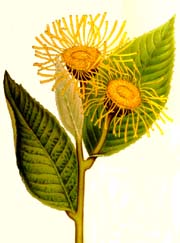 In Russia, elfwort is used somewhat like valerian, for its sedating
qualities. Pliny wrote that the roots of this European native helped
digestion and "cause mirth." It was raised in medieval gardens,
especially in monastery physick gardens. It was brought to North America
by the Colonists and has become naturalized here. Although this does
not look anything like a Mercury herb, Culpeper
believed it to be so because of its usefulness against lung
complaints. Still, it is Sun-like in its effects, being warming and
drying. It's an old remedy for tough coughs and against poison,
especially venomous bites. Top
In Russia, elfwort is used somewhat like valerian, for its sedating
qualities. Pliny wrote that the roots of this European native helped
digestion and "cause mirth." It was raised in medieval gardens,
especially in monastery physick gardens. It was brought to North America
by the Colonists and has become naturalized here. Although this does
not look anything like a Mercury herb, Culpeper
believed it to be so because of its usefulness against lung
complaints. Still, it is Sun-like in its effects, being warming and
drying. It's an old remedy for tough coughs and against poison,
especially venomous bites. Top
The fragrant root is a nice addition to pot pourri and like orris root,
is a good scent fixative. It also yields a blue dye when it is combined
with whortleberries and ash. In Wales it was put into ale with other
herbs as a treatment for
poisonous bites. The ale had to be drunk at the New or Full Moon after
the afflicted person had bathed in the sea. In the past the root was
put into ale or beer to give it a nice smell, and it is still used to
flavor absinthe and vermouth, absinthe's poor cousin. Elfwort is also
known as elecampane, elf-doc, elfdock, dyavosyl (devil's
strength), wild sunflower, alycompaine, nursewort, yellow starwort, eolone
(Old English), velvet dock, scabwort (because it cured sheep
of the disease
called scab), horseheal, and horse-elder. This plant was
given the species name "helenium" because Helen of Troy was picking its
flowers when she was
kidnapped by Paris. Top
How to Grow Elfwort
Start inside 7-10 weeks before the last frost in your area. Barely
cover to germinate in 7-10 days at room temperature. After the last
frost, transplant outside to full sun or partial shade and rich soil
with a touch of acidity (you can add some peat or some pine needles -
not too much). Place the plants 18-36"/.4-.9m apart. The spread of the
rosette of leaves is pretty wide. Harvest the root in the second or
third spring or fall of its growth, slice it in pieces 1/2"/1cm thick
while it is still fresh, and then dry. This plant can be slow to get
going if it encounters a setback like extreme heat or drought when it
is young. Otherwise, it will grow up to 8 ft/2.4m and flower in the
second year. Elfwort is a perennial down to -40F/-40C.
We added this to our garden in the spring of 2021, during which it grew a very large rosette of leaves (individual leaves measured close to 12" in length). In 2022, the stalk grew to over 6'/2m tall and we had beautiful, yellow flowers throughout our New England summer (even amidst the drought and with minimal watering). After harvesting the seeds, we cut back the dry stalk and new leaves begin to form again in mid-April.
General
growing info.
Top
Inula helenium
Elfwort Seeds
75 seeds $4.25
Inula helenium
Dried Elfwort Root
1 ounce $3.00
Uses in
Witchcraft & Magic:
Elf Magic
Protection Spells
Divination
Dreamwork
Shape
Shifting
Acquiring Magical Skills
Love Magick
Honoring
Odin
Mercury/Sun Herb
© 2004-2024 Alchemy Works; No reproduction without permission