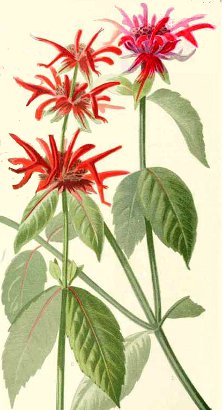
 Monarda didyma
Bee Balm
This friendly herb attracts bees, butterflies, and hummingbirds to your garden and makes a nice substitute for mint (it's a mint relative). Just as the columbine resembles a group of doves, the petals of bee balm look like a stork's head. This as well as the nice, light aroma of this plant show its Air nature. Try it as a component in a divination tea, along with, for instance, mugwort, clary sage, catnip, and chamomile. Because of its high essential oil content, this herb is a good antiseptic, especially for chest complaints, which also fits the Air paradigm. Most web pages and entries in herb encyclopedias cite this herb's thymol as responsible for its ability to kill germs, but it actually has a wealth of essential oils, with a special emphasis on citrus components. That explains why it can make black tea taste like Earl Grey (try at 3 parts gently dried bee balm leaves to 1 part black tea). But it also includes some of the same essential oil ingredients found in nutmeg, rosemary, pennyroyal, celery, basil, lavender, cardamom, and oregano. Truly a varied herb! This combination might explain why some people describe this herb smelling like pineapple, some like mint, and some faintly like oregano. Like many mints, it is good for the digestion. The Cherokee had a number of uses for this herb, including making poultices for headaches and as a tea for overly excited people and those needing sleep. Perhaps that is why it is sometimes designated as a Mercury herb. But its use as a calming tea is pretty interesting, since in the old American medical system known as Eclectic medicine, this herb was considered stimulating. The flowers are edible and the petals make a wonderful garnish or salad ingredient. (1 teaspoon dried or 1 tablespoon fresh per cup). It's also nice to add a slightly minty or pineapple flavor to wine. Young leaves can be added to salads. This old-fashioned flower is a good choice for cottage gardens. This North American native plant has been cultivated in American gardens since 1755. During the American Revolution, colonists drank tea made from this plant instead of British black tea. The red flowers (the wild version has only red flowers) came to symbolize resistance to the British, and the plant was dubbed "liberty tea." Also known as Oswego tea, red mint, scarlet monarda, and firecracker plant. This named variety was developed to resist mildew and has flowers of scarlet, magenta, rose, mauve, pink, and purple that appear all summer as long as you pinch off expiring flowers. Top
How to Grow Bee Balm
Surface
sow (don't cover with soil; just press in and keep moist with bottom
watering). Germinates in 3 weeks at cool room temperatures (60F/16C).
Sow in mid-February up north to have transplants ready to flower
in spring, or sow in fall. It likes rich soil; fertilize periodically
with fish emulsion and kelp. Grows 30"/75cm tall. Space at
12-18"/43-72cm apart. Morning sun and afternoon shade (east
side of your house) is best. Don't plant too thickly, or it
is susceptible to mildew, and don't let it dry out or put it in
a very dry area; like all mints, it likes water. It is a companion
plant for tomatoes. They make nice cut flowers and keep
their colors when dried as well; strip leaves off stalks to dry
for tea, then hang stalks upside down to dry. Bee balm is a perennial
down to zone 4. Divide the roots every 3-4 years to make more plants
or to renew the original plant. It spreads by rhizomes but is easy
to pull up where it's not wanted. General
growing info Top
Monarda didyma
Bee Balm
20 seeds $4.00
Uses in Witchcraft & Magic:
Divination Tea
Air
Herb
© 2006-2024 Alchemy Works; No reproduction without permission