 Rudbeckia
occidentalis
Rudbeckia
occidentalisBlack Coneflower
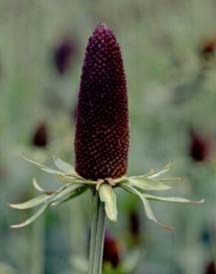
This unusual black-eyed Susan is the black eye without the Susan! It has no petals, only green sepals (the part that encloses the bud), which surround a long black cone. When the cone first forms, it has a gold ring of pollen around it that stands out like a Saturn ring (not visible in this pic). Considering that the actual flower parts (the cone) are black, this makes a neat Pluto plant, and it's then especially fitting that the golden petals are absent (absence being a Pluto quality). Its flower essence is used for reaching the hidden depths of the soul and helps with contacting one's shadow side. The flowers have strong stalks and are good cut or dried (great altar decorations). Keep them picked to get more flowers. The foliage is nice grey-green and goes well with other greyish/silver plants like wormwood, poppy, lavender, and California poppy. This is a good plant for cottage gardens and as a background for other black flowers. This magick herb flowers July-October and grows up to 39 in/1 m, although there are reports of it getting 5 ft/1.5m. It is a fast-growing plant and can bloom in 12 weeks. Bees, butterflies, and goldfinches love it. This native of western North America is also known as western coneflower, black cap coneflower, and black beauty coneflower. Top
How to grow Black Coneflower: Sow from late winter to mid summer, barely covering to germinate in 2 weeks or less at room temperature. Or sow on Winter Solstice (see special directions on the Solstice Sowing page). Transplant to full sun/partial shade and ordinary soil that is not too dry. Keep flowers picked to produce more blooms, and cut back old stems when new shoots start to show in the fall. This plant self-seeds when happy and spreads by roots as well--it can be invasive. It is a perennial in zones 3-9 (down to -40F/-40C). General growing info. Top
Rudbeckia
occidentalis
Black Coneflower
40 seeds $3.50
Uses in Witchcraft & Magic:
Contacting the
Shadow Side
Pluto Herb
© 2004-2024 Alchemy Works; No reproduction without permission