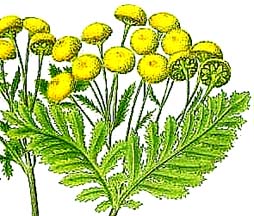
 Tanacetum
vulgare
Tanacetum
vulgareTansy
This plant has long played a role in funeral rites, in particular, those that speak of death and rebirth. The leaves of this magick herb were tucked around the body before burial, and the herb's pentrating scent was thought to help guide the spirits of the dead on their journey. The name "tanacetum" apparently came from the Greek word for immortality, because the flowers take a long time to fade (and perhaps because of the plant's association with the dead). Indeed, when Zeus fell in love with the beautiful young man Ganymede, he was given tansy to make him immortal. The rebirth theme is carried through in this magick's herbs use in celebrating Ostara, a festival of rebirth (and fertility). Tansy is sacred to Mary, but consider this Venus herb when honoring dark goddesses, due to its connection to death. This magick herb also is helpful in protection spells, especially in terms of protecting against the authorities and for journeys. It is excellent for strewing or for cleansing the space of the magick circle. It is associated with Gemini. In the Victorian language of flowers, this herb represents a declaration of war upon the recipient, perhaps because of its traditional association with death.
Mundane Uses
In England, it was incorporated into cakes during Lent, perhaps in memory of the Jewish use of bitter herbs at Passover, or perhaps as a nod to its use as a spring tonic. Together with lovage and yarrow, it was made into a cordial once popular in Britain. You can rub this herb on meats to give them a flavor like rosemary. The flowering tops make a mustard yellow dye on wool with an alum mordant, and the young shoots make a green dye. Tansy has a nice herby smell that repels bugs both in dried form and in the garden - plant it at the four corners of your vegetable or henbane plot to help repel bugs like the Colorado potato beetle. It also repels flies, ants, and fleas, but its flowers will attract beneficial insects like ladybugs and green lacewings as well as bugs that are just nice to look at, like butterflies. It's a good herb for composting, because it concentrates minerals in its leaves, but consider that it can also draw up heavy metals from the soil, so if your soil is contaminated, you can use tansy as a removal system. Just remember not to compost the vegetation in that case. Instead, bag it and take it to the landfill.
Toxicity
Don't make a tea of this plant - it can kill. Generally, herbs that are good pesticides should not be taken internally, although this is not true of plants in the mint family (tansy is in the aster family). Don't allow dogs to chew on it, as it can kill small ones who eat it. It is toxic to all mammals. Although we have noticed that our cats ignore it. Most animals avoid strong-smelling plants.
This European native has become naturalized in North America, so much so that some consider it a weed (as with many herbs), and it is indeed a very hardy plant, practically rambunctious in its liveliness. However, it is not the same thing as tansy ragwort, which is considered a noxious weed in many states and which is much more toxic. Tasnsy spreads by rhizomes and like human beings can be a rampant colonizer, so grow it in a container or surrounded by turf that is regularly mowed if you want to contain it. But this desire to spread together with its insect repelling abilities make tansy a good choice for growing around fruit trees and berry bushes. Tansy is also known as bachelor's buttons, bitter buttons, buttons, ginger plant, and gold-buttons.
How to Grow Tansy
 Sprinkle
on the surface of moist planting medium and gently press in with your
fingertip. Use bottom watering or misting so as not to dislodge the
seeds and put them in indirect light and room temperature to germinate
in one month. If they are balky, give one month of cold stratification
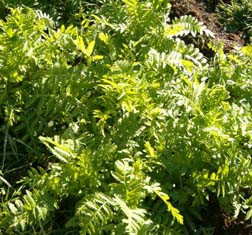
at freezing temperatures. Our founder started the tansy in the photo from seeds sowed simply in cellpacks. Tansy gets 24-36in/60-90 cm tall
and is hardy in zones 3-9 (down to -40F/40C). Tansy needs full sun and
can tolerate wind but not salt. It can grow in pretty much any
conditions except shade. In rich soil it will spread much faster. General
growing info
Sprinkle
on the surface of moist planting medium and gently press in with your
fingertip. Use bottom watering or misting so as not to dislodge the
seeds and put them in indirect light and room temperature to germinate
in one month. If they are balky, give one month of cold stratification
at freezing temperatures. Our founder started the tansy in the photo from seeds sowed simply in cellpacks. Tansy gets 24-36in/60-90 cm tall
and is hardy in zones 3-9 (down to -40F/40C). Tansy needs full sun and
can tolerate wind but not salt. It can grow in pretty much any
conditions except shade. In rich soil it will spread much faster. General
growing info
Tanacetum
vulgare
Tansy
100 seeds $3.50
This seed cannot be shipped to Montana or Wyoming.
Uses
in Witchcraft & Magic:
Honoring the Dead
Celebrating Ostara
Protection Spells
Connecting to Gemini
Venus Herb
© 2000-2024 Alchemy Works; No reproduction without permission