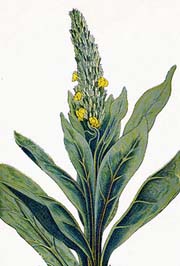
 Verbascum
thapsus
Verbascum
thapsusGreat Mullein
This magick herb has been protective in various cultures. In ancient Greece, Ulysses defended himself from Circe's magic with mullein. In the old days in France, people would pass sprigs of mullein through a fire on St. John's Eve (better known among us as Midsummer) in order to protect cattle from sickness caused by sorcery. In England, putting mullein under the butter churn could bring back butter that had been witched away. European travellers carried mullein or stuffed it into their shoes to protect them from attacks by wild animals (and also to make walking more comfortable). Nowadays, dream pillows are stuffed with mullein to protect against nightmares. It is mixed with dill, salt, and fennel and sprinkled around haunted areas to repel malicious spirits or ghosts, and it is a substitution for graveyard dirt in the recipes of various spells. Top
This magick herb also has various connections to the idea of returning, which we can see as a Saturnian power (emphasizing borders and staying inside them). For instance, in Great Britain it was used to help bring back children who had been kidnapped by fairies. Various Native Americans knew a good thing when they saw it and used this Eurasian native that became naturalized in North America to return people to their right mind. For instance, the Hopi mixed the leaves with osnomodium to be used as a smoke by crazy people and those who had been betwitched. The Navajo wrapped the leaves in a corn husk to be smoked to help a mind return if it was lost, and the Potowatami smudged unconcscious people with the leaves to help them return to consciousness. Consider mullein useful in centering the spirit and add it to the pipe smoked as an aid to astral work. Top
Mullein was also a
ceremonial smoke for the Isleta and Thompson
Indians. Various sources on the web mention that mullein is
one of Woden's Nine Herbs, but looking the actual charm, we don't think
this is likely. Top
Many disagree about the
planetary correspondence of this magick herb. Agrippa said it belonged
to Mercury.
The leaves do have a high
concentration of aluminum, a Mercury metal, and in the past this herb
was given to affect the mind, for instance, to bring back people who
were unconscious or who were mentally ill. Culpeper thought it
was a Saturn
herb, on account of its medicinal actions. As a biennial, it is
also a slow herb (slowness is a Saturnian quality), taking a
year to produce a rosette of leaves and
only flowering in the second year. The seeds likewise show a Saturnian
slowness in their long
viability - up to 35 years. It also has a Saturnian love for
borders, growing along roads, train tracks, or on the edge of
woodlands,
and for areas that are rejected for agricultural purposes ("waste
lands"). Some argue that it is a Fire herb, because
its dry leaves make an excellent tinder and it gets one its common
names, hag's taper, from the practice of dipping the stalks in fat to
make a quickie torch (by the way, the "hag" in "hag's taper" was
originally the word "hedge"). Finally, the leaves contain iron
and the fuzz that covers them is a softer version of prickliness, so
this can also be viewed as a Mars herb. Indeed, it has played a part in various
Mars-ruled activities, such as hunting: Navajo hunters rubbed a tea of
mullein leaf on themselves and their horses for strength. Top
Mundane Uses
 In ancient
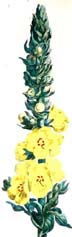
Rome, women used mullein flowers to give their hair yellow
highlights. It's said that Quaker women, who were not allowed to use
makeup, rubbed their faces with the leaves to make them rosy - the fuzz
is irritating to some people. The Atsugewei rubbed their bodies with
mullein leaves during sweat
lodges. The Abnaki made a necklace for teething babies from the root. A
tea from this herb is slightly sedating; boil 1 tablespoon of dried
leaves or root (or for a sweeter tea, the fresh or dried flowers) in 1
cup of water for 5-10 minutes, then strain through a coffee filter to
remove the hairs, if using the leaves. The leaves were smoked in the
past to
soothe irritation caused by coughing from TB, asthma, or general lung
irritation. The leaves also contain a small amount of rotenone, an
organic pesticide. Birds enjoy eating the seeds. This plant has many,
many names: it is also
known as Aaron's rod, Adam's flannel, beggar's blanket, beggar's
flannel,
beggar's stalk, big taper, blanket herb, blanket leaf, bullock's
lungwort, candlewick plant, clot, clown's lungwort, cow's lungwort,
cuddy's lungs, devil's-tobacco, duffle, feltwort, flannel leaf, flannel
plant, fluffweed, graveyeard candles, great mullein, hag's taper,
hare's beard,
hedge-taper, ice leaf, Jacob's staff, Jupiter's staff, lungwort,
lus mor [great herb], miner's candle, mullein, mullein dock, old man's
flannel, Our Lady's
flannel, Quaker rouge, rag paper, shepherd's club, shepherd's staff,
St. Peter's staff, torches, torchwort, velvet dock, velvet plant, white
man's-footsteps, wild ice leaf, witch's candles, witch's taper, woolen,
and wooly mullein.Top
In ancient
Rome, women used mullein flowers to give their hair yellow
highlights. It's said that Quaker women, who were not allowed to use
makeup, rubbed their faces with the leaves to make them rosy - the fuzz
is irritating to some people. The Atsugewei rubbed their bodies with
mullein leaves during sweat
lodges. The Abnaki made a necklace for teething babies from the root. A
tea from this herb is slightly sedating; boil 1 tablespoon of dried
leaves or root (or for a sweeter tea, the fresh or dried flowers) in 1
cup of water for 5-10 minutes, then strain through a coffee filter to
remove the hairs, if using the leaves. The leaves were smoked in the
past to
soothe irritation caused by coughing from TB, asthma, or general lung
irritation. The leaves also contain a small amount of rotenone, an
organic pesticide. Birds enjoy eating the seeds. This plant has many,
many names: it is also
known as Aaron's rod, Adam's flannel, beggar's blanket, beggar's
flannel,
beggar's stalk, big taper, blanket herb, blanket leaf, bullock's
lungwort, candlewick plant, clot, clown's lungwort, cow's lungwort,
cuddy's lungs, devil's-tobacco, duffle, feltwort, flannel leaf, flannel
plant, fluffweed, graveyeard candles, great mullein, hag's taper,
hare's beard,
hedge-taper, ice leaf, Jacob's staff, Jupiter's staff, lungwort,
lus mor [great herb], miner's candle, mullein, mullein dock, old man's
flannel, Our Lady's
flannel, Quaker rouge, rag paper, shepherd's club, shepherd's staff,
St. Peter's staff, torches, torchwort, velvet dock, velvet plant, white
man's-footsteps, wild ice leaf, witch's candles, witch's taper, woolen,
and wooly mullein.Top
How to Grow Mullein
Barely cover
seeds to germinate in 12-15 days at room temperature.
Transplant 12-18"/30-45cm apart in full sun. Mullein is hardy in zones
4-9 (down to -30F/-34C). The first year the plant forms a rosette of
leaves. In the second year, a huge stalk can shoot up 84"/213cm. The
fuzzy leaves are pretty much deer-proof, but the skin of sensitive
people can be irritated by the hairs. Mullein makes a huge amount of
seeds. When the stalk turns brown, cut it off
and shake the seeds out into a bag or leave them for the birds to eat. General growing
info Top
Verbascum
thapsus
Mullein
500 seeds $4.00
This seed cannot be shipped to Hawaii.
Uses in Witchcraft & Magic:
Protection Spells
Dreamwork
Centering
Hunter's Charm
Graveyard Dirt
Mercury/Saturn Herb
© 2000-2024 Alchemy Works; No reproduction without permission